

Pathways to Opportunity Panel Highlights Stronger Connections Across Education System
Wednesday, October 14, 2026
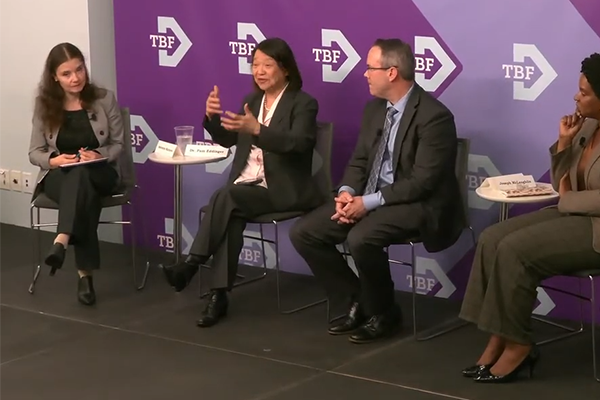
Bunker Hill Community College President Pam Eddinger recently joined education and civic leaders for Pathways to Opportunity: Boosting College Enrollment and Completion of Boston Public Schools Graduates, hosted by The Boston Foundation. The discussion examined data on college enrollment and completion among Boston Public Schools graduates and explored how educators, policymakers, employers and community partners can help more students succeed after high school. Speakers included Massachusetts Secretary of Education Stephen Zrike and BPS Superintendent Mary Skipper.
 Research by the Boston Private Industry Council shows that while college enrollment and completion rates have stabilized following pandemic-era declines, significant gaps remain. Panelists agreed that improving outcomes requires more than getting students into college. Students need coordinated academic, financial, social and career supports to persist and graduate.
Eddinger emphasized the role community colleges play in building those supports. Drawing on Bunker Hill’s experience with Guided Pathways, she described an approach that connects clear academic and career progress with structured onboarding, individualized plans, experiential learning and basic-needs support. She stressed that these student-facing strategies depend on less visible but essential investments in institutional infrastructure, including data systems and the ability of colleges and partner institutions to share information and coordinate services.
Eddinger also highlighted the importance of measuring success across the entire education ecosystem. She noted that the goal of Early College is to help students successfully navigate postsecondary pathways—not necessarily to enroll them at Bunker Hill. Students who move on to four-year institutions represent a successful outcome as well.
Looking ahead, Eddinger identified academic preparation in mathematics and English as a critical next challenge. With the region’s economy increasingly dependent on health care, life sciences and technology, she argued that students need strong academic foundations to access those opportunities and ultimately advance to bachelor’s and graduate-level education.
She also underscored the importance of engaging the families and communities surrounding students, particularly at a college where many students are parents themselves. Across the discussion, Eddinger’s message was consistent: stronger outcomes require clear pathways and sustained collaboration across K–12, higher education, employers, families and community organizations.
Watch the panel below.